1. Project Overview
The client is a US service business with a long sales cycle, a large lead base, multiple communication channels and a sensitive document-signing workflow
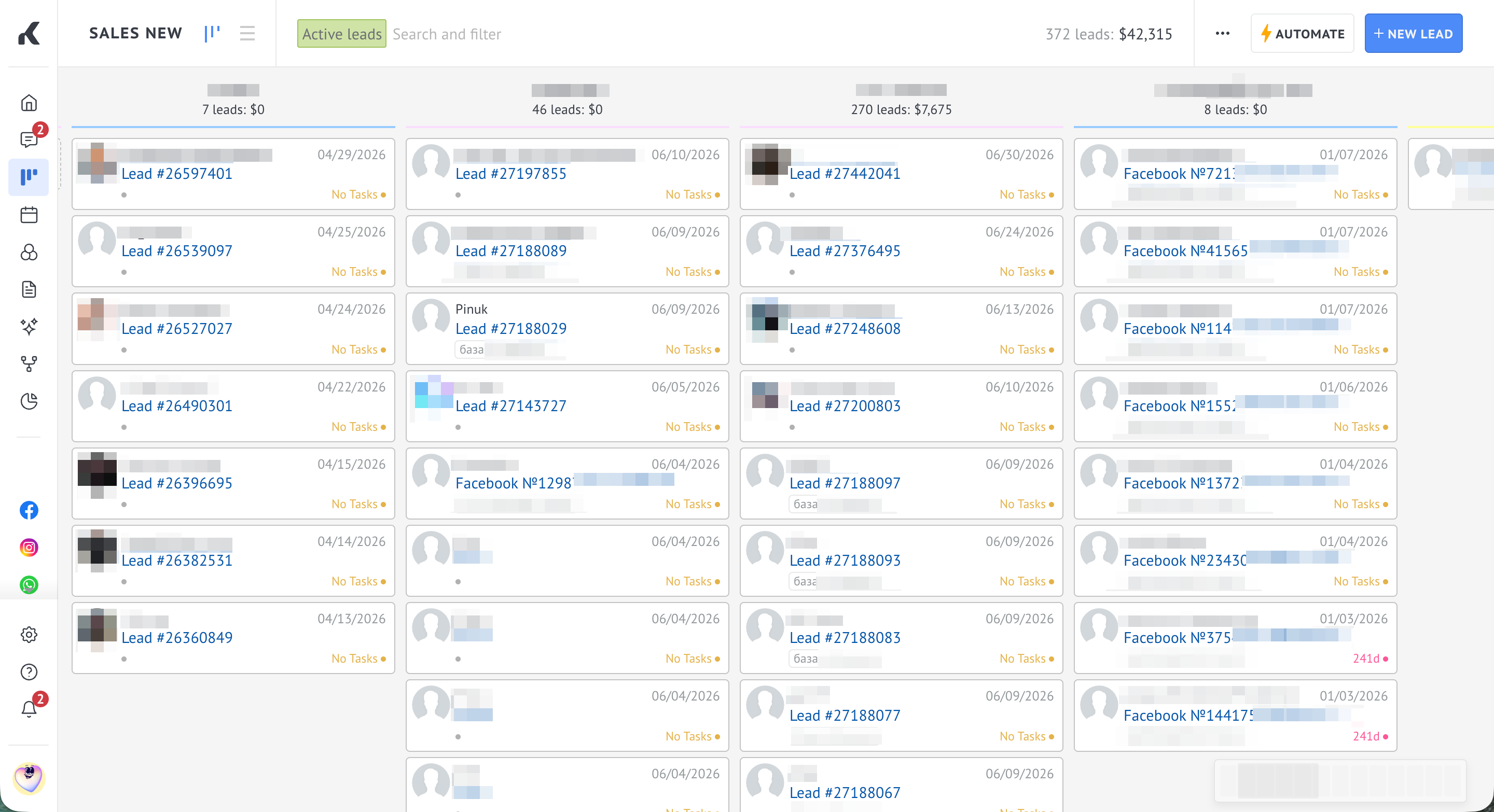
Kommo was already the central CRM, but the business needed a clearer sales intelligence layer: where the main pipeline value lived, which opportunities had the strongest potential, which channels performed best and how to move clients from first request to documents and payment faster
My role was not just to connect APIs. I had to understand the existing sales process, find the money inside CRM data, design a control layer over Kommo and launch integrations for documents, SMS and sales operations
2. What The Client Had
•CRM needed executive visibility: Kommo contained a large active pipeline, but the owner needed a clearer view of pipeline, revenue and priorities
•Sales operations had to become measurable: the important question was not only how many leads existed, but where money moved and which stages deserved attention
•Documents were a separate process: agreement signing had to be connected to a specific deal, template and link-to-sign flow
•SMS had compliance constraints: the provider could be integrated technically, but US messaging required toll-free registration, opt-in wording, privacy language and approval
•AI was attractive, but the first step had to be grounded: before building a large AI layer, the business needed a fast data-backed view of where CRM control was failing
3. Scope
•Audit Kommo pipelines, stages, custom fields, users, leads and tasks
•Identify pipeline value, successful revenue, stage bottlenecks and the fastest places to strengthen sales through automation
•Launch an integration bridge between Kommo, DocuSign and the SMS provider
•Build logic for deal-specific document templates and signing links that work from CRM context
•Prepare SMS delivery without violating US compliance requirements
•Design the first Sales Control Layer: rules, audit, revenue visibility, CRM notes and AI-assisted recommendations
•Keep the system safe: dry-run mode, idempotency, controlled CRM writes and no chaotic mass outreach
4. Solution
CRM Audit & Sales Leakage
•Collected the structure of Kommo pipelines, stages, users, custom fields, leads and tasks through the API
•Built an audit snapshot that exposed the value map inside CRM: active pipeline, completed revenue, high-potential stages and channel-level opportunities
•Analyzed stage value, won revenue, active pipeline and the channels where automation could strengthen sales fastest
•Replaced the vague “call everyone again” approach with a data-driven path: first find where the process leaks, then automate only the important control points
Kommo Integration Bridge
•Launched a Node.js / Express bridge for Kommo webhooks and integration actions
•Split API clients by responsibility: Kommo, DocuSign and SMS provider
•Designed integrations to work in phases, so documents, messages, audit jobs and manager tasks would not block one another
•Planned idempotent CRM writes so webhooks or daily audits would not create duplicate tasks and notes
DocuSign Flow
•Analyzed the agreement process and launched the connection between Kommo deal, document template and signing flow
•The flow creates an envelope, generates a stable signing link and writes the result back into CRM
•Documented an external blocker: production approval in DocuSign could not be solved by code and had to pass account/app review
•The real value was not pressing one integration button, but turning the signing process into a controlled architecture with a manager fallback
SMS & Compliance
•Verified SMS delivery through the provider and prepared a registration package for US toll-free messaging
•Identified that SMS could not be launched as a simple technical integration: opt-in wording, privacy-policy language, sample templates, business verification and campaign approval were required
•Designed a safe fallback: if SMS was unavailable because of compliance approval, the signing link could still be created and sent by a manager through another channel
•This kept the integration useful without pushing the business into risky messaging behavior
Sales Control Layer & AI
•Designed the first AiSS layer — AI Sales Supervisor for Kommo
•The principle was simple: deterministic rules keep the process inside controlled boundaries, while AI helps phrase manager-facing recommendations, risk summaries and next-best actions
•The first scope did not depend on DocuSign or SMS, so the business could receive value quickly: daily audit, revenue visibility, stage recommendations and CRM notes
•The launch path included dry-run mode, pipeline/stage limits, batch processing and manual review of the first high-priority deals
5. Outcome
•A clear view of where the strongest pipeline value lived inside Kommo
•An owner-level audit snapshot based on sales-control gaps, not vague impressions
•An integration bridge architecture for Kommo, DocuSign and the SMS provider
•A launched document-signing flow tied to CRM deals and template logic
•A compliance-aware SMS plan that did not try to bypass US messaging rules
•A launched Sales Control Layer: rules, AI recommendations, CRM notes, idempotency and dry-run safety
•A practical path from “we have many leads in CRM” to “we know where the money is, what already works and what should be scaled”
6. Business Impact In Numbers
The audit made the scale visible: the CRM contained 3,542 open deals and about $623,765 in active pipeline value. This gave the owner an executive view of where the money was concentrated and which segments deserved attention first
The audit also split the pipeline into practical business segments: sales, repair, credit build, funding, old-base and ads. Instead of a vague feeling that “there is a lot inside CRM”, the client received a structured map of revenue opportunities, active stages and scalable channels
After launch, the control layer turned Kommo into a sales intelligence layer: the owner could manage from pipeline and revenue data rather than instinct. The CRM recorded 117 won deals and about $261,950 in successful revenue across completed stages, creating a stronger base for follow-up, reactivation and AI-assisted sales operations
7. Technical Result
This case was about turning CRM from a passive deal database into an operational sales-control system
Kommo stayed familiar to the team, but a new layer made pipeline value, revenue movement, document steps and compliance blockers visible. It did not replace sales work; it gave the owner control over how CRM turns requests, documents, messages and follow-up into revenue